INITIALIZING_ACCESS_PROTOCOL...
← Back to Tools Console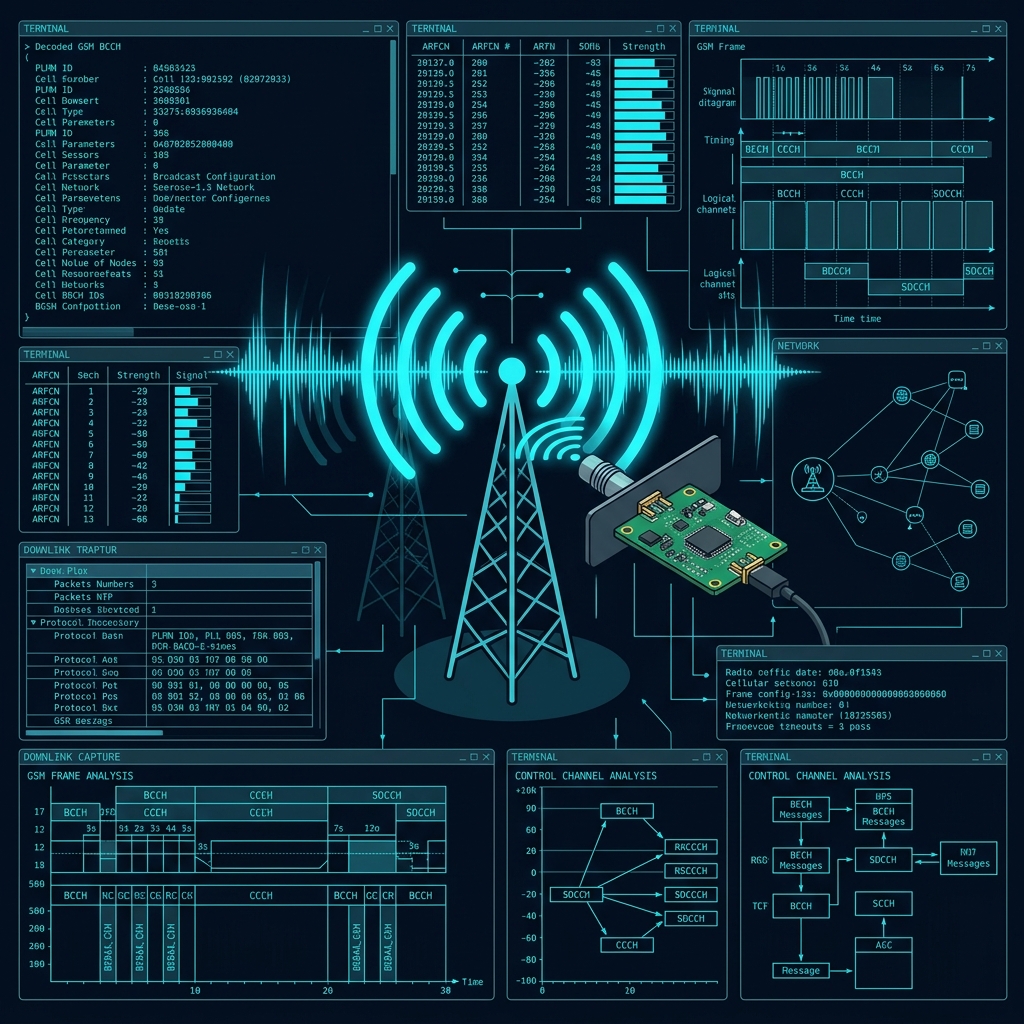

[ SYSTEM_NOTICE :: TOP_RESEARCH_NODE ]
System Node · Research Ready · GR-GSM
GR-GSM — GSM Transmission Receiver Blocks
Research Overview
TL;DR — GR-GSM is a GNU Radio extension providing purpose-built receiver blocks for GSM downlink capture and decoding. It implements the complete GSM physical-layer pipeline — GMSK demodulation, burst de-interleaving, and channel decoding — for all burst and logical channel types including BCCH, CCCH, SACCH, and TCH. Captured frames are exported in GSMTAP encapsulation for real-time Wireshark decoding via the grgsm_livemon utility. Security researchers use GR-GSM to assess GSM fallback network exposure, verify cipher suite enforcement (A5/1, A5/3, or A5/0 null cipher), and map control channel parameters across carrier deployments.
GR-GSM extends the GNU Radio ecosystem with purpose-built receiver blocks for GSM downlink capture, implementing the complete physical-layer pipeline from FCCH detection and burst timing synchronization through GMSK demodulation, differential NRZ decoding, burst de-interleaving, and channel decoding of all GSM burst types: Normal Bursts (NB), Synchronization Bursts (SB), Frequency Correction Bursts (FB), Access Bursts (AB), and Dummy Bursts (DB). The gr-osmosdr source block provides a unified hardware abstraction across RTL-SDR, USRP, BladeRF, and other compatible receivers.
Captured bursts are mapped to logical channel types (BCCH, CCCH, SACCH, SDCCH, TCH) and exposed over a local UDP socket in GSMTAP encapsulation, feeding real-time Wireshark decoding via the grgsm_livemon companion utility. Security researchers use GR-GSM to assess legacy GSM fallback network exposure: decoding BCCH System Information blocks reveals whether A5/1 vs A5/3 ciphering is consistently enforced, and SACCH monitoring detects A5/0 null cipher usage that exposes subscriber communications.
Cell reselection parameter analysis identifies configurations that create IMSI-catcher-style downgrade windows, while neighbor cell lists from SIB3 enable systematic mapping of the surrounding GSM topology. Reliable decoding depends on oscillator correction using Kalibrate.
Key Research Applications
- >Capturing BCCH System Information blocks to document MCC/MNC/LAC/CI parameters and map GSM fallback cell coverage footprints
- >Detecting A5/0 null cipher usage by monitoring cipher mode settings in SACCH measurement report frames during passive capture
- >Assessing CCCH paging channel density to estimate residual subscriber activity on carrier GSM networks during LTE/5G migration audits
- >Verifying that operators claiming full LTE coverage produce no decodable GSM TCH traffic that could expose subscriber communications
Technical Specifications
Operational Mode
Level 1 certification required. Targeting RAN infrastructure layers.
Compatibility
SDR hardware (USRP/BladeRF) required.
Secure Audit Threat Vectors
GSM remains active as a mandatory fallback protocol across Africa, Southeast Asia, and parts of Europe, and as a voice/data fallback for IoT and M2M deployments on virtually all global carriers. Despite being a legacy standard, its security weaknesses are well-documented and actively exploited: A5/1 stream cipher is broken by rainbow table attacks using pre-computed Kraken tables, A5/0 null cipher provides zero confidentiality, and GSM lacks mutual authentication — enabling IMSI catcher deployment without the network detecting the rogue cell.
GR-GSM enables auditors to assess the real-world risk exposure of these weaknesses on specific carrier deployments. BCCH capture reveals which cipher suite each cell enforces, SACCH monitoring detects A5/0 null cipher usage, and cell reselection parameter analysis identifies configurations that create automatic downgrade conditions when a higher-signal adversarial cell is introduced. Mobile operators risk significant regulatory exposure if audits confirm subscriber call interception is technically feasible on their GSM fallback network.
Oscillator calibration via Kalibrate is required before any capture session to ensure reliable burst synchronization.
Frequently Asked Questions
What is GR-GSM?
GR-GSM is an open-source telecom security utility in the RAN category. GR-GSM is a GNU Radio extension providing purpose-built receiver blocks for GSM downlink capture and decoding. It implements the complete GSM physical-layer pipeline — GMSK demodulation, burst de-interleaving, and channel decoding — for all burst and logical channel types including BCCH, CCCH, SACCH, and TCH. Captured frames are exported in GSMTAP encapsulation for real-time Wireshark decoding via the grgsm_livemon utility. Security researchers use GR-GSM to assess GSM fallback network exposure, verify cipher suite enforcement (A5/1, A5/3, or A5/0 null cipher), and map control channel parameters across carrier deployments.
Which category does GR-GSM belong to?
GR-GSM is categorized under RAN in the TelcoSec Tools console. This category covers tools used for auditing Radio Access Network air interfaces, base station broadcasts, and SDR-based signal capture.
Does GR-GSM support active GSM uplink transmission or injection?
GR-GSM is designed as a passive downlink receiver and does not include uplink transmission capabilities in its core distribution. This is intentional: transmitting on GSM frequencies without a license is illegal in virtually all jurisdictions, and the passive-only design eliminates accidental transmission risk. Active GSM injection for controlled laboratory research requires separate tools — OsmocomBB for raw Layer-1 uplink access, or YateBTS/Osmocom NITB for full base station simulation in shielded environments.
Which SDR hardware is recommended for GR-GSM capture in field assessments?
For single-channel BCCH capture at 900 MHz, an RTL-SDR dongle provides sufficient performance after oscillator calibration with Kalibrate. For wideband simultaneous capture of multiple GSM carriers — useful when assessing carriers with fragmented 900 MHz and 1800 MHz deployments — the USRP B200mini or B210 is preferred due to its 56 MHz instantaneous bandwidth and superior 12-bit ADC dynamic range relative to the RTL-SDR's 8-bit sampling.
ADVANCED_TRAININGRAN Security PathRecommended for: GR-GSM
Master GR-GSM Security at the Academy
Upgrade your skill set from running automated modules to manual exploit engineering. Learn deep protocol auditing, signaling vulnerabilities, and baseband hardware analysis inside our virtual environments.
•Hands-On Virtual Labs
•SDR & RF Sandbox Kits
•Industry-Recognized Certs
Research Credentials
Tool Feedback
Found a bug, have a feature request, or a technical question about GR-GSM? Send it directly to the research team.