INITIALIZING_ACCESS_PROTOCOL...
← Back to Tools Console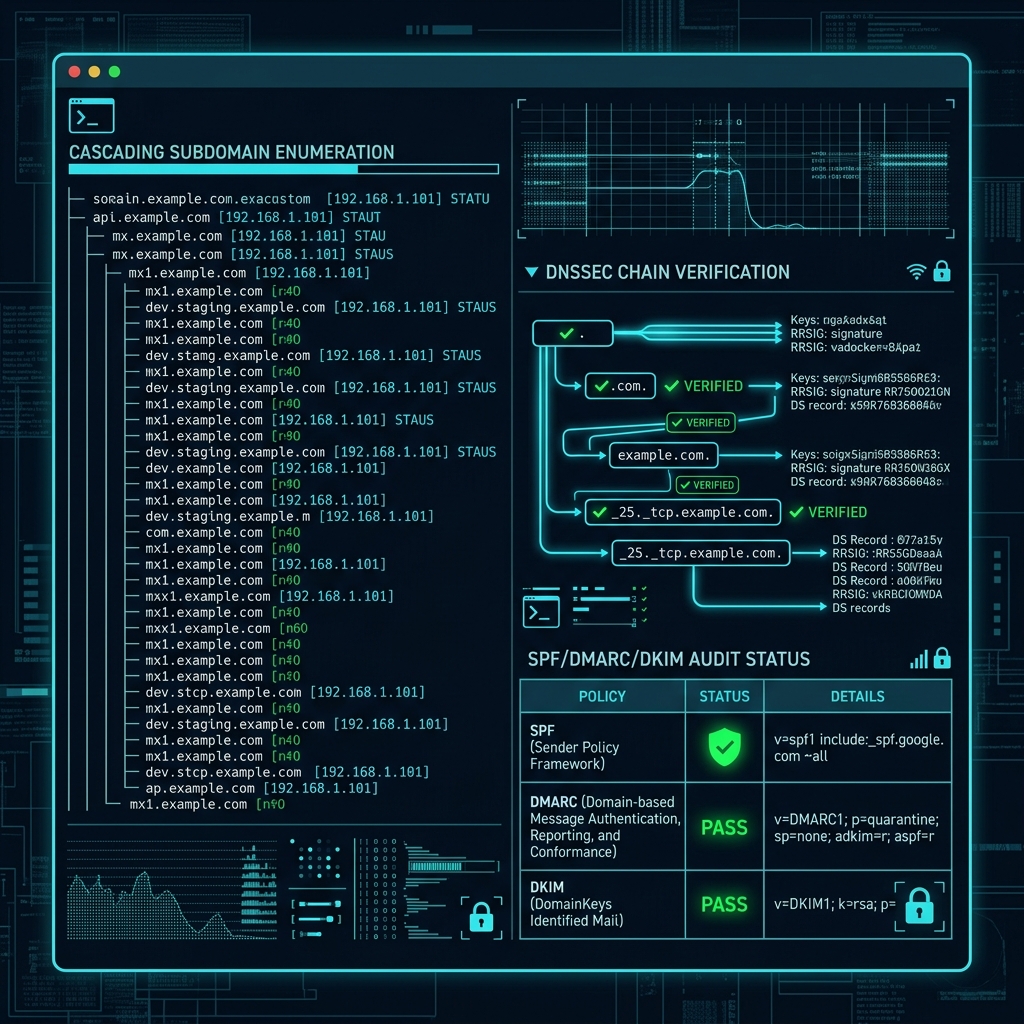

[ SYSTEM_NOTICE :: TOP_RESEARCH_NODE ]
System Node · Research Ready · RDNSX
RDNSx — DNS Security & Subdomain Auditing
Research Overview
TL;DR — RDNSx is a high-performance, multi-purpose DNS analysis framework written in Rust. Supports 27 DNS record types, concurrent processing of 50+ simultaneous queries, advanced subdomain brute-force with wildcard detection, DNSSEC zone-walking, and email security (SPF, DMARC, DKIM) enumeration. Results can be exported to Elasticsearch, MongoDB, or Cassandra for large-scale telecom recon operations.
RDNSx approaches telecom DNS security by combining high-concurrency Rust async I/O with deep protocol support spanning 27 DNS record types. Built on the Tokio async runtime, it dispatches up to 50 simultaneous resolver queries without thread-per-connection overhead — making large carrier FQDN namespace enumeration practical within live engagement time constraints. Its DNSSEC zone-walking module follows NSEC/NSEC3 chain signatures, detecting opt-out flags that allow unsigned delegations within enterprise telecom zones, while a wildcard detection engine filters false positives from catch-all DNS responses.
Telecom-specific record types are first-class targets: NAPTR records expose IMS P-CSCF service routing paths, SRV records reveal VoLTE registration endpoints, and PTR reverse lookups map core network node hostnames from captured GTP tunnel IP ranges. The integrated email security module correlates SPF mechanism severity (softfail vs hardfail), DMARC enforcement progression (none → quarantine → reject), and DKIM selector exposure to produce a unified phishing risk score for the operator domain.
Results export directly to Elasticsearch, MongoDB, or Cassandra for longitudinal OSINT correlation across multi-carrier assessments. For physical-layer reconnaissance that complements DNS-layer findings, pair RDNSx with SDR hardware profiled in the SDR Capabilities Intelligence database.
Key Research Applications
- >Auditing carrier DNS infrastructure for unrestricted AXFR zone transfer exposure before a core network penetration test engagement
- >Enumerating APN FQDN structures (IMS P-CSCF, EPC PGW/SGW) for GTP tunnel injection path discovery during authorized assessments
- >Validating SPF/DMARC policy hardening across operator administrative domains to close phishing spoofing vectors targeting NOC credentials
- >Longitudinal DNSSEC signature chain monitoring to detect unsigned NS delegation anomalies across assessment cycles
Technical Specifications
Operational Mode
Level 3 certification required. Targeting Security infrastructure layers.
Compatibility
Standard Linux environment with kernel-level protocol stacks.
Secure Audit Threat Vectors
Telecom networks depend on DNS for critical internal routing: NAPTR records direct SIP registration to IMS P-CSCF nodes, SRV records locate VoLTE media relay endpoints, and GTP-C/GTP-U routing depends on FQDN resolution for PGW and SGW discovery within evolved packet core infrastructure. Misconfigured DNS creates exploitable attack surfaces: unrestricted AXFR zone transfers expose the full internal namespace, DNS cache poisoning can redirect signaling paths to adversary-controlled nodes, and subdomain takeover via expired NS delegation records allows impersonation of operator API endpoints.
SPF softfail policies on administrative telecom domains create phishing vectors to compromise NOC credentials via spear-phishing campaigns mimicking carrier portals. RDNSx audits DNSSEC signature chain completeness including NSEC3 opt-out detection, validates zone transfer restrictions on all authoritative servers, and identifies DKIM selector exposure that could enable email header spoofing against carrier business domains used in critical B2B communications.
Frequently Asked Questions
What is RDNSx — DNS Security Toolkit?
RDNSx — DNS Security Toolkit is an open-source telecom security utility in the Security category. RDNSx is a high-performance, multi-purpose DNS analysis framework written in Rust. Supports 27 DNS record types, concurrent processing of 50+ simultaneous queries, advanced subdomain brute-force with wildcard detection, DNSSEC zone-walking, and email security (SPF, DMARC, DKIM) enumeration. Results can be exported to Elasticsearch, MongoDB, or Cassandra for large-scale telecom recon operations.
Which category does RDNSx — DNS Security Toolkit belong to?
RDNSx — DNS Security Toolkit is categorized under Security in the TelcoSec Tools console. This category covers tools used for auditing telecom security architecture including DNS, signaling protocols, and firmware vulnerability research.
Does RDNSx require root privileges to perform telecom DNS scans?
RDNSx does not require root privileges for passive DNS enumeration, DNSSEC zone-walking, or AXFR probing. Root access is only needed when binding to privileged listener ports below 1024 for custom resolver configurations. Standard telecom OSINT workflows — including SPF/DMARC correlation and subdomain brute-force — run under a normal user account on any Linux system with network access to the target resolver.
Can RDNSx enumerate private APN DNS zones inside GTP tunnel networks?
Yes. RDNSx supports custom upstream resolver specification, allowing queries to target private DNS resolvers accessible within a GTP data tunnel endpoint. This enables mapping of APN FQDN namespaces including PGW, SGW, and HSS hostnames in enterprise and MVNO network environments, provided the assessment has appropriate authorization and network access to the GTP-reachable resolver.
ADVANCED_TRAININGSecurity Security PathRecommended for: RDNSx — DNS Security Toolkit
Master RDNSx — DNS Security Toolkit Security at the Academy
Upgrade your skill set from running automated modules to manual exploit engineering. Learn deep protocol auditing, signaling vulnerabilities, and baseband hardware analysis inside our virtual environments.
•Hands-On Virtual Labs
•SDR & RF Sandbox Kits
•Industry-Recognized Certs
Research Credentials
Tool Feedback
Found a bug, have a feature request, or a technical question about RDNSx — DNS Security Toolkit? Send it directly to the research team.