INITIALIZING_ACCESS_PROTOCOL...
← Back to Tools Console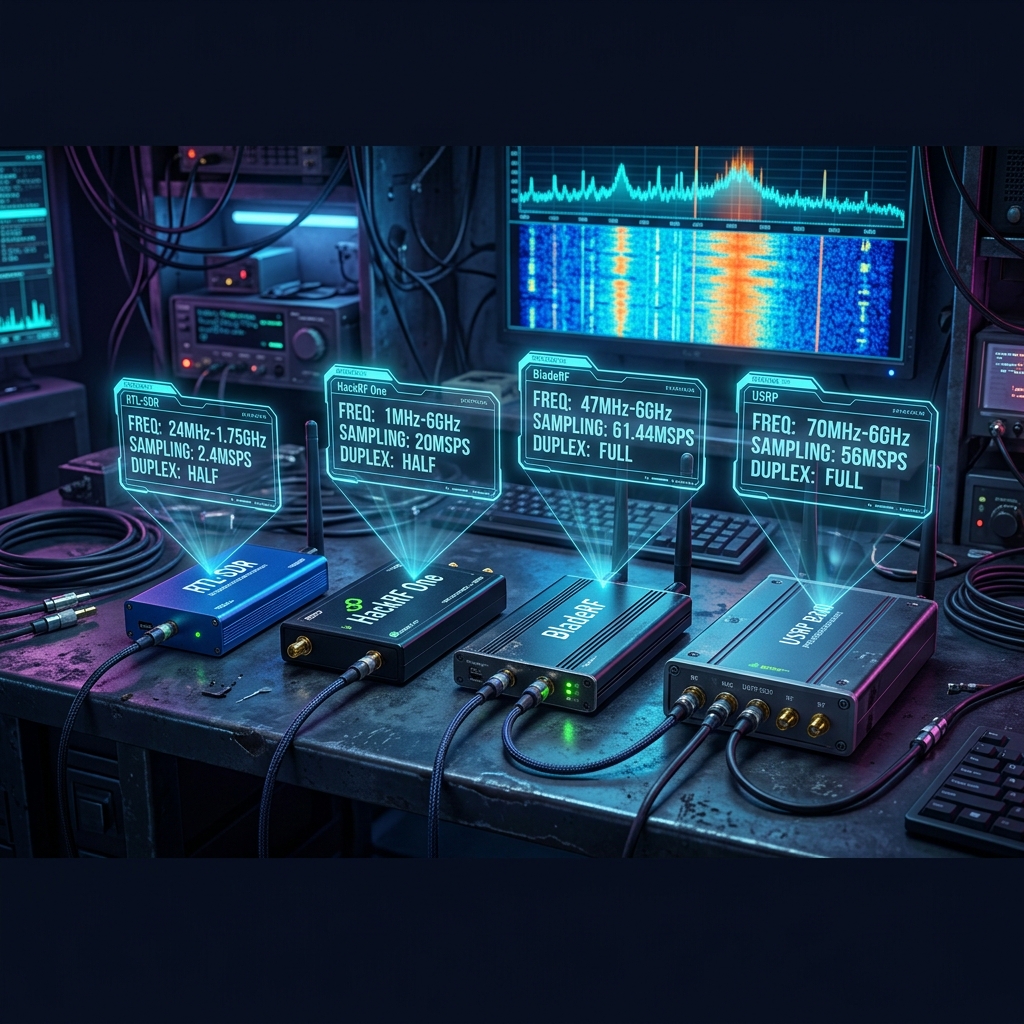

[ SYSTEM_NOTICE :: TOP_RESEARCH_NODE ]
System Node · Research Ready · SDR-CAPABILITIES
SDR Capabilities Intelligence Database
Research Overview
TL;DR — This tool provides a comprehensive database of SDR hardware capabilities, ranging from hobbyist devices like RTL-SDR to professional-grade USRP and BladeRF units. It enables researchers to compare sampling rates, frequency ranges, duplex modes, and FPGA capabilities to select the optimal hardware for specific attack vectors like IMSI catching or SS7/NR signaling analysis.
The SDR Capabilities Intelligence Database structures hardware evaluation around the performance envelopes demanded by cellular security assessments, providing a normalized comparison layer across devices from sub-$30 RTL-SDR dongles to professional USRP X410 and Ettus N310 platforms. Each hardware profile captures the parameters that determine suitability for a given scenario: instantaneous bandwidth (critical for 5G NR sub-6 GHz channels requiring 100 MHz sampling), ADC dynamic range and bit depth (determining passive capture sensitivity in dense urban RF environments), TX power output (defining safe injection ranges for cable-connected lab scenarios), and FPGA resource availability for real-time baseband processing.
The database cross-references FDD versus TDD duplex mode support against target band plans — a critical distinction for LTE and 5G NR research where simultaneous TX/RX isolation is required — and maps FPGA toolchain availability (Xilinx Vivado, Intel Quartus, GNU Radio FPGA companion) to the open-source cellular stacks most deployed in security contexts: srsRAN, OpenBTS, OsmocomBB, and OpenAirInterface.
Band coverage matrices are correlated against regional frequency allocations to accelerate hardware selection for operator-specific assessments. Use this database to identify transceivers for signal processing pipelines in GNU Radio, passive downlink analysis in GR-GSM, and oscillator calibration using Kalibrate.
Key Research Applications
- >Selecting hardware for wideband 5G NR sub-6 GHz passive capture requiring ≥100 MHz instantaneous bandwidth and 12-bit ADC resolution
- >Evaluating FPGA-equipped platforms (USRP X310, Ettus N310) for real-time srsRAN NR deployment in controlled LTE/5G security research
- >Comparing TX power output and duplex mode specifications to determine safe injection ranges for isolated RF-shielded lab scenarios
- >Mapping hardware frequency range coverage against regional spectrum allocations to confirm band suitability for specific carrier assessments
Technical Specifications
Operational Mode
Level 1 certification required. Targeting Mobile Equipments infrastructure layers.
Compatibility
Standard Linux environment with kernel-level protocol stacks.
Secure Audit Threat Vectors
Hardware selection is one of the most consequential early decisions in a cellular security assessment: choosing a device with insufficient instantaneous bandwidth means a 5G NR capture session fails before it starts, while an underpowered ADC produces SNR-limited captures that miss weak-signal control channels in urban deployments. For passive 5G NR sub-6 GHz capture, minimum requirements include 100 MHz instantaneous bandwidth and a 12-bit ADC — ruling out RTL-SDR and HackRF while qualifying USRP B210, USRP X310, and LimeSDR USB.
For rogue eNB detection research requiring simultaneous TX/RX isolation, full-duplex FDD capability is mandatory — ruling out TDD-only and receive-only hardware classes. The database also captures FPGA toolchain compatibility: srsRAN NR deployment on USRP X310 requires specific UHD version compatibility with Xilinx FPGA images, and the database surfaces these constraints before a researcher encounters them mid-engagement.
For hardware-dependent workflows like GNU Radio flowgraph design and GR-GSM passive capture, selecting verified-compatible hardware prevents wasted configuration effort during active assessments.
Frequently Asked Questions
What is SDR Capabilities Intelligence?
SDR Capabilities Intelligence is an open-source telecom security utility in the Mobile Equipments category. This tool provides a comprehensive database of SDR hardware capabilities, ranging from hobbyist devices like RTL-SDR to professional-grade USRP and BladeRF units. It enables researchers to compare sampling rates, frequency ranges, duplex modes, and FPGA capabilities to select the optimal hardware for specific attack vectors like IMSI catching or SS7/NR signaling analysis.
Which category does SDR Capabilities Intelligence belong to?
SDR Capabilities Intelligence is categorized under Mobile Equipments in the TelcoSec Tools console. This category covers tools used for auditing mobile modem firmware, baseband processor diagnostics, and device-level cellular protocol stacks.
What is the minimum SDR hardware specification for GSM passive downlink capture?
GSM passive downlink capture requires at minimum 2 MHz of instantaneous bandwidth to cover a single 200 kHz GSM carrier with guard bands. A low-cost RTL-SDR dongle ($25–35) meets this minimum for single-channel BCCH monitoring with GR-GSM, provided the oscillator is calibrated with Kalibrate to correct typical 50–150 ppm drift. For simultaneous multi-carrier monitoring or any 3G/4G capture, USRP B200mini or BladeRF x40 class hardware is recommended.
How should researchers choose between FDD and TDD hardware for LTE security research?
For passive receive-only LTE monitoring, both FDD and TDD hardware work — even receive-only devices like RTL-SDR are sufficient for downlink PDCCH observation. For active scenarios requiring simultaneous TX and RX (such as rogue eNB simulation in a shielded lab), hardware with full-duplex FDD capability and sufficient TX/RX isolation (USRP B210 or N210) is required. The SDR Capabilities database explicitly flags duplex mode for each device.
ADVANCED_TRAININGMobile Equipments Security PathRecommended for: SDR Capabilities Intelligence
Master SDR Capabilities Intelligence Security at the Academy
Upgrade your skill set from running automated modules to manual exploit engineering. Learn deep protocol auditing, signaling vulnerabilities, and baseband hardware analysis inside our virtual environments.
•Hands-On Virtual Labs
•SDR & RF Sandbox Kits
•Industry-Recognized Certs
Research Credentials
Tool Feedback
Found a bug, have a feature request, or a technical question about SDR Capabilities Intelligence? Send it directly to the research team.